Neverendums

Hi.

I know that this subject has been argued over continuously for the past few days, and you might think there’s really not that much more to say, however you could be wrong.

For those of you who haven’t visited this site before, my name is Max and I’m an Anglo-Romanian who lives in Bucharest. My dad is a brit who moved here in the 90’s. At time of writing I am nearly fourteen.

All of you should know by now that last week the UK voted to leave the European Union. In my opinion, that has just doomed the nation, the EU itself, and quite possibly the global economy. You’ve already heard all of the leave and remain arguments, so I won’t bother writing them here, however I will say what I think of a few of them and what my opinion is on this mess.

Being a child raised in a conjuncture of Romanian and British culture, I reckon that I get the “full picture” of both leave and remain arguments. I, as a teenage boy, think that the UK must remain and I’m not the only one; hundreds of thousands of teenagers and possibly even children think so. And that’s because it’s us, the annoying bunch of hunchback chavs and emos that one day will have to lead the world through whatever will come next. We, as children have seen what the EU is good for and how it will help us as adults. In the EU, you can live, work, travel and love in 27 other countries, 14% of the world’s total, with all of that paperwork and hours spent in embassies and government buildings eliminated. The ideals of the EU are wonderful and unprecedented in the world; a whole continent, full of diverse cultures and histories united as one global superpower.

Of course, the leave supporters insist the EU is broken and dying, and it may be so. But here’s my question, can’t we work together to try and eliminate the problems with the EU so that we won’t have this argument again? Referring to my statement above, the EU is not perfect, it most certainly isn’t, but there are 28 countries full of educated minds that can make it be. That’s the problem with leave supporters in my opinion; they’re simply not giving the EU a chance.

With the departure of the UK, my own life goals have practically gone out the window. I am admittedly very lucky to even be in such a situation (dual nationality), and I planned to use this to my advantage; I’d have done university for free in Scotland as a Romanian/EU citizen, then perhaps live there or in England for a few years, work for the British Antarctic Survey etc. I can’t do that now.

In all fairness, I’ve even experienced the benefits of the EU as a student in the Erasmus+ programme. I and three of my friends firstly hosted Scottish kids after which we ourselves were hosted by them. We were joined by children of four other nationalities, in which expeditions were also performed.

There’s no need for visas, you show up at the airport with a passport and go (in the Schengen area, not even that). In theory, I could’ve even stayed in Scotland and started studying there, I wouldn’t need any studying visas/permits, no permanent residence visas either. My parents would’ve needed to have signed a few documents and of course, I’m over-simplifying, but the point still stands.

In Scotland I met new people and made friends which I am willing to visit as often as possible, and the possibility of that happening has gone down the rabbit hole because my future has been decided by people who in ten years will be dead and won’t have to face any consequences.

The good news is that Scotland may get another independence referendum and Northern Ireland may get its first, because most of the people in those areas were sane and preferred staying in. There are even some who think London should become a city-state like Singapore, even Sadiq Khan has said the idea interests him, and he has indeed demanded greater autonomy for London.

And let’s not even talk about what might happen in Gibraltar.

After Brexit.png
Hmm…

I’ll probably be happy if this happens because it’ll feel as if some justice has been done towards the people of Britain, but at the same time it’ll mean there won’t be a Britain. I’d be happy for the people of Scotland and Northern Ireland, but what about all the English and Welsh who wanted to remain? I, myself would be the most confused because I would feel robbed of my home country, one which I wasn’t even given a chance to explore and fully understand. Is that really what is required to stay in the EU? Is it even worth it? Many moral dilemmas ensue, the point is how far are people willing to go?

I’m not even sure which attitude to take; the rebel who was robbed of his vote or the hopeful who thinks it might work out. Because, let’s remember, Article 50 has not been triggered yetWho knows, maybe it might never happen.

While we wait for the day of tomorrow and whatever the future might bring, let’s just sit back and laugh at the irony of it all. In the worst case scenario, we’ll all move to Canada.

Straight Outta Europe.jpg
You twats.

Dambovita

Hi.

Sorry I’ve been absent the past few months, but as you can imagine I’ve been really rather busy, um… studying.

Children of the Forest
Mhm…

If you’ve ever been around Unirii you are sure to have noticed some water thing to the east. That’s a river called the Dambovita.


Of course if you’re from around here or if you’ve been here many times you’ll probably already know that, but even if you are I bet you know hardly anything about the Dambovita. OK, it flows through Bucharest, it’s got cement on the sides… That’s about it, isn’t it? Don’t worry, for I am here to clear up some things about the Dambovita you never even knew you wanted to know. Let’s begin.

First off, it’s highly debated whether the Dambovita is actually a river anymore. I mean sure, it sources somewhere in the Carpathian mountains, flows through the Dambovita county and then into Bucharest. Here’s where it gets complicated.

The river can practically be emptied and refilled at any given time

After entering Bucharest, the Dambovita flows into a large reservoir named Lacul Morii (Mill Lake). From here on downstream the river is controlled by a series of one-way locks all the way to the outskirts of Bucharest. Not only does this mean that the Dambovita is practically a canal, but you can’t sail on it either. That kind of defeats the purpose, doesn’t it? I say that, but at the same time the actual reason as to why the Dambovita was canalised lies deep in Bucharest’s history.

Initially, the Dambovita was a river in every sense of the word: twirly, flowing and clean. That’s right, foreigners used to praise citizens for keeping their river so clean. The problem was that, as all other rivers, the Dambovita’s debit was unpredictable and as such it often flooded, sometimes destroying mills and homes. Due to this, in the late nineteenth century the course of the river was heavily altered and it was also dug into a deep trench in such a way that flooding became impossible. This also formed an oxbow lake which we now call Lake Cismigiu.

Pre-70’s Dambovita. The location is now Piata Unirii.

The Dambovita remained this way for a long time until… Teacup* showed up!

Being the megalomaniac we all love him for, in the 70’s he changed the landscape of Bucharest forever. He decided to canalise the Dambovita as part of a much larger plan of systematising the city centre. You know, the big boulevards, the metro and so on. To make more room, part of the Dambovita was built over around Unirii. The river still flows there, right underneath people’s feet.

Of course, Ceausescu wanted the Dambovita to become much more than a simple river/canal. His idea was that a large port be built on the southwest outskirts of Bucharest and the construction of a massive canal all the way to the Danube. The water would have been supplied by two reservoirs, only one of which was ever built: Lacul Morii. The other one, Lake Vacaresti has somehow become a national park.. It’s crazy, I know.

Construction started on the canal in the 80’s, and stalled in 1990. Even today you can see a bit of what it was meant to look like if you go all the way to the end of the embankment, in Catelu. This is also a big traffic avoiding route when returning from the seaside on the A2. Pro tip!

That’s the basics of what you need to know.


* – In Romanian culture, megalomaniac dictator Nicolae Ceaușescu is sometimes known as ‘Ceașcă’, which in English means ‘teacup’.

Utterly Useless

Romania today is probably the top country in the ‘number of useless things’ categories. Think about it; at least half of everything in Romania is generally pointless.

‘What do you…” That sentence is incomplete because that was you just realising that what I just said is true.

  • The Dambovita? Canalised for the sake of… Uhm…
  • Palace of the Parliament? Well, so that the parliament gets some room to breathe. What do you mean it only uses one third of it?
  • That bit of motorway near a town no one’s ever heard of? To alleviate high numbers of potential imaginary traffic!
  • Class 0? So that little kids can go to kindergarten at school!
  • Mamaia?

Continuing the trend of utterly useless things that fill this country, I found out this week that Romania has a National Terrorist Alert System. What.

SNAT
As it appears on the SRI website

According to the SRI website, the SNAT was started in 2004 with the objective of helping plan anti-terrorist activities in Romania. Well excuse me, but according to Wikipedia there has not been a single terrorist attack on Romanian soil since 1921*

Not only that, but the current ‘level’ of a possibility of a terrorist attack is ‘cautious’. That’s fine until you notice that there is a ‘low’ option as well. Cause let’s be honest, ISIS attacks in Romania are something you don’t really hear about every day. Or any day, for that matter.

Something I find completely outrageous though is the fact that the level was raised to ‘moderate’ in 2008 during the NATO Summit. Just why? I mean, Romania isn’t a particularly rich country, its HDI is comparable to that of Libya and we’ve always got Uncle Sam on our side (or so they say). Why bomb Romania?

And let’s not forget that while we seem to be ready for a terrorist attack we’re still struggling to keep idiots out of metro depots.

*The only other terrorist attack in Romania was a plane hijacking in 1947, however that wasn’t technically on Romanian soil…

British Baseball

If you’ve been reading my posts for a while, you may already know that I am a cricket fan. Seeing as a lot of readers of mine are Romanian, I figured I might as well tell them about what they’re missing out on.

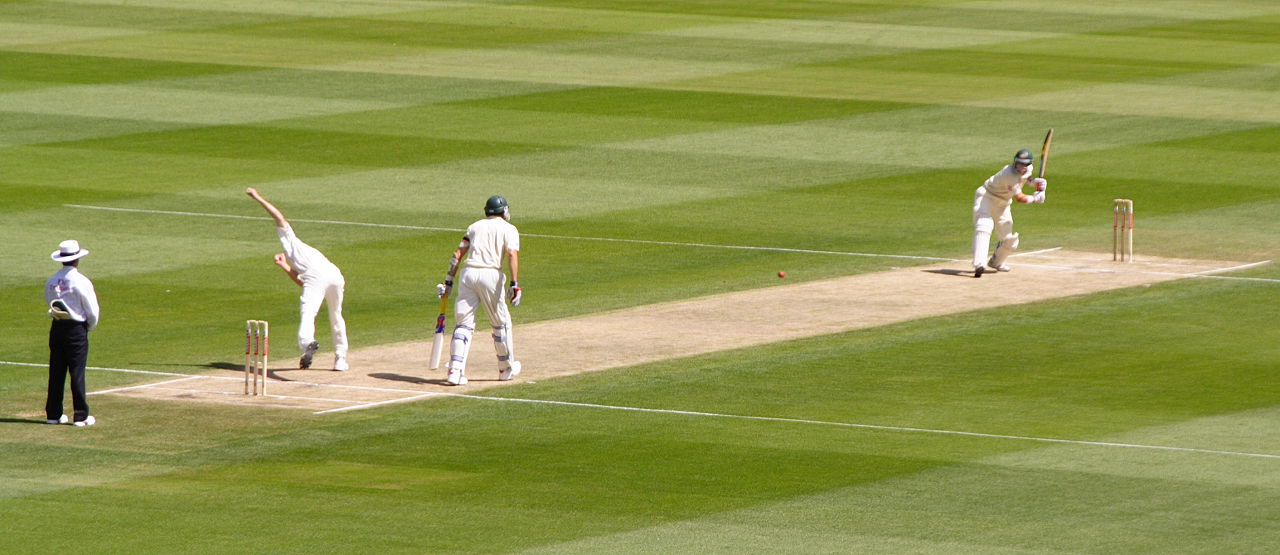
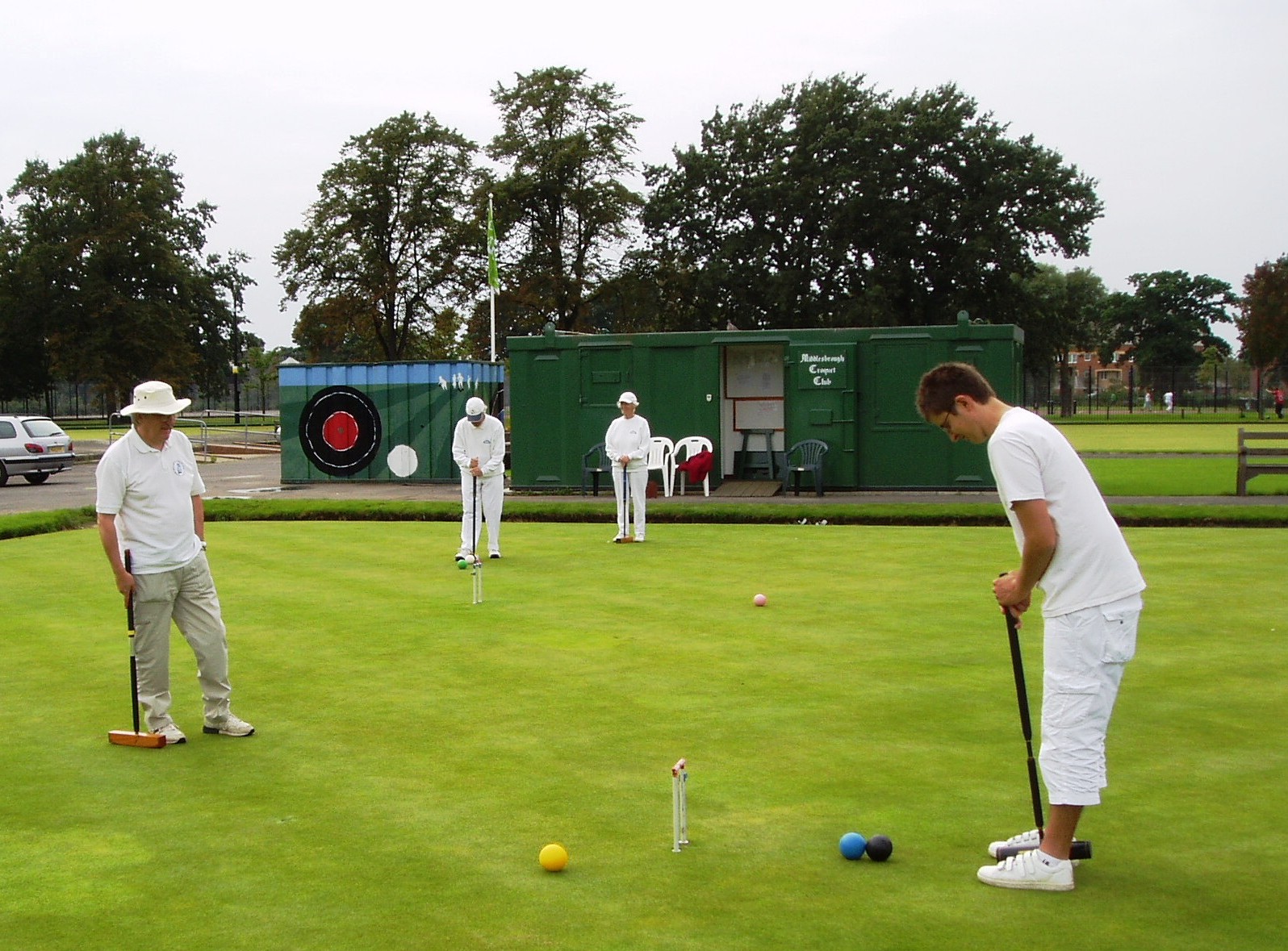
First off, people must learn the difference between cricket and croquet. Yes, they’re both of British origin and people generally think of them as ‘posh people’s games’, but they are two completely different things. Basically, cricket is the one with the bat and the ball that isn’t baseball while croquet is supersized golf.

Cricket
Croquet

Right. Now on to the game itself. Cricket is apparently the second most-popular sport in the world, the International Cricket Council (ICC) having over 100 members.

The field.
The Players
The players and their positions.

Cricket is played between two teams, in our case blue and white. In this case team white is batting and team blue is bowling or fielding. The batting team’s job is to hit the ball thrown by the bowler and score runs by running between the wickets. They can score four runs if the ball rolls to the boundary and six if it goes over it.

The job of the bowler is to throw the ball and try to hit the stumps behind the batsman. If he does this, the batsman is considered ‘out’ and cannot bat for the rest of the innings.

The fielders’ job is to catch the ball hit by the batsman and throw it back to the bowler as quickly as possible. The wicket keeper’s job is to catch the ball, if the batsman doesn’t hit it or doesn’t hit it very hard.

There are ten ways to get a batsman out, the most common ones being:

  1. The ball hits the stumps.
  2. The ball hits the batsman’s leg, and his leg was in front of the stumps.
  3. The fielders catch the ball hit by the batsman before it touches the ground.
  4. The batsman hits the ball and the wicket keeper pushes it into the stumps.
  5. The bowler hits the stumps while the two batsmen are running (after one of them had previously hit the ball).

Unlike other games, cricket isn’t a timed game. Instead, a game is divided into innings and overs. An over is composed of six balls (throws), and an innings is over either when the over limit has been reached or all batsmen are out. There are three types of cricket based on overs:

  1. Twenty20 (T20) – Two innings composed of twenty overs each.
  2. One Day International – Two innings composed of fifty overs each.
  3. Test – Four innings (two for each team), no over limit however the game must end after the end of the fifth day. Fifth day.

That’s essentially it. Of course, there are lots of other laws that apply, however I’m sure you can look them up yourself. Now I’d like to talk about the ICC.

Unlike other more normal sports, membership in the ICC is a hierarchy. If a country has just joined, it is an affiliate. If cricket develops well in that country, it becomes an associate. If in that said country cricket is basically a national sport, it is considered a full or test member. Here’s a map:

2015
Red – Full member Orange – Associate member Blue – Affiliate member Brown – Suspended member Grey – Former member

Members mustn’t always be countries. For example, the England team represents both England and Wales and the West Indies team represents a bunch of island nations plus Guyana.

Romania is currently an affiliate member and has been since 2013. There are currently eight cricket clubs throughout the country: four in Bucharest, three in Timișoara and one in Cluj-Napoca. The current national champions are Băneasa. You can find out more on the Cricket Romania website.

I, trying to spread cricket in Romania to millennials, have decided to start up a cricket club of my own:

The quote at the bottom reads: “Shaorma is the only way up” – Florin Salam, 2015

It was kind of a joke to be honest and I am really considering changing the name so people don’t associate us with the guys from Dristor.

So far I’ve got two guys to join and the list is hoped to grow. Our current pitch is a bit underdeveloped, possibly because it’s on concrete in the car park near my house.

Landslide Victory

A long, long time ago I published one of my first ever posts on this blog: Politics in the Classroom. I talked about the complex political system that I had to put up with in fifth grade. I am now in seventh grade, and I’ve decided it’s time for an update on what goes on.

The hierarchy that I did remains the same, however the current situation is:

Headmaster – Form Teacher – Professors – Class President – Class Vice president – Homework Checkers – Kids who gather money for something – Kids whose mums gather money for something – Typical Student.

I’ve added the headmaster at the top because duh, and I’ve got rid of the kids who get the baton and milk. This is because of a few incidents that happened last year. For example, someone once threw a milk carton out the window, and once we all had a fight where we threw batons around like grenades. As such, the position has since been retired. I’ve also added the status of ‘vice president’ who as you can imagine acts like a back up president. I suppose the school constitution says so.

Something else that has changed is that this year we had democratic elections for class president. And I thought I’d join in.

You see, because I am a massive nerd on basically everything, I knew from the start that I would win. Because we used a First-Past-The-Post system, that meant that out of all the numbers on the board I had to get the highest one. There were five candidates, so seeing as there were 30 pupils and 30 / 5 is 6, all I had to do was get seven votes or more. I got fifteen.

In high-pitched Matt Bellamy voice: Yeeeeaaaaah!

It must also be said that I had the best campaign speech, as well. I started it off with “Has anyone got a Strepsils?”. They were sold from that moment, I bet. What’s more, the person who came in second place was the former president and her speech was pure political nonsense. She’ll go far, I think. She is now vice president.

I know that being the class president sounds epic (because it is), but in all fairness you can’t really do that much. You can’t exactly give free 10’s to everyone and neither can you introduce a totalitarian dictatorship. You know, the good stuff.

I personally find this change of tactics a nice one, because in fifth grade the president was chosen by the form teacher in a very absolute monarchical way. This did not go down well with the students. In sixth grade, the subject wasn’t even brought up and the president ran for a second term without elections or even another appointment If the elections wouldn’t have happened, I think the future would be similar to what Geography Now says about the pattern of presidential terms in Africa:

Term one: having fun, term two: watching you, term three: felony, term four: you’re getting assassinated.

But seeing as you sometimes have to skip Technology lessons, it’s well worth it.

Bucharest on Two Wheels

Recently, a few thousand cycle enthusiasts protested demanding for better cycling infrastructure in Bucharest. Apparently this is the seventh time this has happened and it doesn’t seem to be getting any better.

In any case, today I’m going to be looking at what has been done and what I think should be done about cycling in Bucharest. First of all, what has the council done in the past? Not a lot…

Around 2009 or so, Oprescu (mayor of Bucharest arrested last week) decided to do something about cycling in Bucharest. After a brief moment of joy, the public realised Oprescu would be doing it the cheap and ineffective way: painting yellow lines on the pavement.

People honestly think of these ‘lanes’ as a bit of a joke and have never actually taken them seriously. Now, six years after the grand scheme of yellow lines on the pavement was put into action, people seem to completely forget they’re there, which can lead to a number of humourous situations…

That looks fine.
Very creative.

In 2014 dedicated cycle lanes were opened on the new Buzesti – Berzei boulevard. They were dead from the start for a number of reasons. They’re way too narrow and as such overtaking is impossible and the boundary between them and the road is represented by a series of poles which are all gone now. Not very good.

Fortunately the first actual, proper cycle lane in Bucharest opened a few months ago along Calea Victoriei. It’s a perfect example of how cycle lanes should be: separate traffic lights for cyclists, clearly marked lanes at junctions and completely segregated from the main road.

Oooh

Some drivers protested against this, because it would take up an entire lane and ’cause traffic jams’. Nonsense.

While lots of people encourage cycling and cleaner methods of transport in general, there will always be those few who can’t accept change and continuously ramble on and on about how ‘cars are more important’. As Captain Slow James May once said:

If someone where to come up with a metal box with wheels that you can control and runs on a fuel that can be found at the end of your street, they would be considered mad.

Because it’s true; cars in general are an old, inefficient idea that could do with replacing. But how would you do something like that? Sure, it may sound impossible but there is a way: you do it very, very slowly.

If we were to build more cycle routes around Bucharest then people would actually consider taking out their bikes and using them more often. This has been done in the Netherlands obviously, and is also happening in London. What I’m trying to say is that if a network of cycle routes would slowly be built around Bucharest, in around a decade or so the opinion on bikes would be very different in the city. Plus, if we start right away we might finish a few in time for 2021.

“But where are you gonna build them!?” you may ask. Don’t worry, I’ve got that covered as well:

Another option that I thought of was inspired by a genius who I saw doing this the other day: what if we kill two birds with one stone and make tram lines separated from the road… WHILE ALSO MAKING THEM USABLE FOR BIKES!? That may be a bit of a stretch, but the point still stands.

To sum up what I have said, instead of solving Bucharest’s traffic problems, run away from them. Actually, pedal away from them.

What’s an Oina?

A few weeks ago, in a log of Mission to the Wilderness, I mentioned a few things about oina, the national sport of Romania. If you’ve ever wondered exactly what oina is, today is your lucky day, as I shall be explaining it.

Oina is a game that is generally played in the countryside, which is why you’ve probably never seen any oina stadiums. Sure, there are a few oina clubs in Romania’s cities, but originally the game was played by shepherds and farmers.

Now for the explanation.

First of all, a diagram of the field:

Oina field
The field

There are three main areas of the field: the batting zone (zona de bătaie), the in game (în joc) and the back zone (zona de fund). There are two corridors the players run on along: the advance corridor and the return corridor.

There are two teams composed of eleven players. One of the teams is batting (la bătaie) while the other one is catching (la prindere).  The catching team has a forward (fruntaș), three midfielders (mijlocași), six halfbacks (mărginași) and a fullback (fundaș). Oina has two referees at each end of the pitch.

The roles of the players on the field

The batting team has a server who throws the ball in the air (like in tennis), a batter who well, bats the ball and the remainder of the team sits in line waiting for their turn. The order is decided before the game and cannot be changed afterwards. The order of roles of a player is the following: in line – server – batter – runner.

The server throws the ball in the air for the batter to hit the ball. If the ball then lands in one of the squares it scores the batting team one point. If the balls goes beyond the back zone it scores the batting team two points. If it goes too far to the left or right it is considered an ‘out’ and no points are scored.

The scoring system of the batting team.

After that, the batter will try to run from the batting zone to the back zone (or batting zone, if returning, without the bat) without being hit. By who will he be hit? Well, he needs to get as fast as he can because the red team will pick up the ball and will try to hit him. While they can only attempt throws from their posts (the circles) they can pass the ball between them to disorientate the runner. The runner can protect himself using his hands. If the catching team manage to hit the runner in any other part of the body, the catching team score two points. The runner proceeds to the next zone (back or batting).

Once in the back zone (having been hit or not), he waits until the next serve to start running back to the batting zone. He can also wait until the next player arrives so they can both leave at once. Once runners arrive back at the batting zone, they wait until the next innings, when the batting and catching teams swap places. This happens after every player from the batting team has served, batted and run. The server for player 11 is player 1.

Oina is a relatively short game, usually ending after half an hour.

Seems simple, right? Because it is. Oina was a very popular sport all the way up until the 70s and 80s, and then it just sorta died out. There are still oina competitions, however good luck finding any of them.

In fact, if there’s any legacy of oina at all is at schools. The modern rules were created in 1899 by Spiru Haret, the Minister of Education at the time along with six other professors from around the country. It was even made compulsory to play oina during PE! Nowadays all we do is throw a relatively heavy ball as far as we can. I did this two years ago, and only now did I actually realise that was an oina ball. That should really give you an idea of just how far oina has gone downhill.

It’s also said that oina was the basis for baseball, the national sport of the US. Seeing as oina comes from way before Europeans even knew about the place, it’s not unlikely but I don’t want to get into any ‘what came first’ arguments.

Seeing as this is the national sport of Romania, I suggest someone actually does something about it and try to bring it back into the mainstream and create an international governing body (it is also played in Moldova). You can find out more about oina on the official website of the Romanian Oina Federation  (be warned that it is in Romanian).

In all honesty I hope that something is done with oina, because it’s a rather cool game. And while making it international would be good, I think it would cost the game some of its ‘Romanian-only’ charm.

The story’s gonna be pretty different when I’ll talk about cricket, though…

Expedition to Omu

Last weekend I went with my sister and my mother to Mount Omu, the second-tallest mountain in Romania. It was an interesting experience. We didn’t really come prepared: my mother forgot her boots and my sister came in shorts.

Knowing that at this time of the year, when seemingly everyone in the country decides to have a last shot at the mountains and/or beach, we arrived relatively early at around nine at the Busteni cable car. We had just missed the first one up, and the queue was already getting tedious. That being said, if we’d come any later we would’ve been there for a good two hours. Also, have you ever noticed that the word ‘queue’ has four pointless letters?

Anyway, after arriving at Babele (a national monument of stone structures at the top of the cable car) we set off on the yellow line route towards Omu. You see, in the Romanian mountains tourist routes are marked with the colours blue, red or yellow along with a shape, like a line or a circle.

It was really cold. Really. It didn’t help that the wind was howling, either. My sister wasn’t really enjoying it in her shorts.

The walk itself was just that, a walk. It took us two hours to reach the top. The views from along the journey are amazing. At the top of the mountain lies a hut (cabana) where we ate cabanos sausages with mashed potatoes. There I attempted to record a video on my phone showing you the sights, but when I got home and watched the video the only thing you could hear was the wind. Sigh.

image
I found this

On the way back to the cable car, we took a slightly different route to the one we came on. It was actually the easier route, used primarily in winter.

image
Sheep

We got back at the cable car at around four, rather tired and eager to get home. We were sat in the queue for the cable car when I started to feel sick. Yes, it turns out I had sunstroke. Because despite it being 15℃ outside, that doesn’t mean the sun disappears.  It was terrifying. My ears felt like they were underwater and my vision was limited to black and white radar quality. A lady working there hurried me outside, so that I could dispose of my lunch, but thankfully I didn’t. Another woman working at a sweet shop nearby had some medicine on her, so I took some and started to feel better. It was not a very pleasant experience at all.

It reminded me of an incident that happened when we went to Cyprus a few years ago. You see, I am literally as white as a vampire and I can blend in with the wall. You can probably imagine how it is when I travel to places like that. I remember that I forgot to put on sun cream for what felt like five minutes, and by the time I got out of the sea I was as red as a traffic light. As such I spent a large portion of the week indoors.

That’s what happened on the mountain, as when I got home I noticed an unwelcome “tan”.

So in conclusion the climb up to Omu from Busteni is rather nice. Unless of course you’re as unprepared as us.

Last Week Tonight

Hi.

First off, this post has nothing to do with John Oliver’s show, it was just basically click-bait. Sorry.

My Mission to the Wilderness ended on August 25th 2015, after a sixteen-hour train journey. I wrote about the trip last year, however this time it was different as we were sleeping in a couchette rather than a first-class cabin. The change was made due to it being cheaper and because my sister is too big to sleep in the same bed as my grandfather.

The main difference between the couchette and first-class cabin is the number of beds. The cabin, for instance only has two beds whereas the couchette can have up to six. Luckily enough, we only had to share our compartment with one guy who lives in Oradea and works in Bucharest. Of course, he ‘only’ does it twice a week and is paid for by the company he works for. Don’t get me wrong; I love travelling by train and especially overnight ones, however if I had to do it twice every week I’d probably go insane.

Oradea and Bucharest are very far away from each other.

I’m not very good at conclusions, so I’ll just say that I enjoyed my mission and will be back next year. That’s all you’re getting out of me.

I have been getting used to life in Bucharest again, however last weekend my family and I went to some friends’ house in Constanta to enjoy the last bit of sun before autumn arrives.

To be honest with you, as much I as I enjoy heat like any other human being I have always enjoyed winter more than the other seasons. I don’t know why, I just like having to put on multiple layers of clothing along with gloves and scarves. Plus I like snow and ice in general, and I also enjoy skiing.

Tomorrow my father and I will go ‘investigating’ on the Bucharest Metro to try and analyse what the best way of doing the Bucharest Metro Challenge is. What I mean is finding shortcuts in stations, the right door to be beside while exiting etc. so that on Wednesday when we actually do the Challenge we’ll hopefully retake the title of record holders.

That’s all for now. G’bye.

Mission to the Wilderness, Log Six

Hi.

So my sister has finally got back from Ianculesti and I thought it could be good material for a log post.

First of all, an introduction: Ianculesti is a village a kilometre away from the DN19 via a well-paved drum comunal.

Ianculesti is where my grandmother spent her childhood and most of her (and respectively my) family still lives there.

Ianculesti has arguably more of a ‘quiet village’ feel than Petresti, largely because it’s a mile* away from the main road and because of the way the villagep is built. What I mean is that Petresti basically has all of its houses built on the DN19, whereas Ianculesti’s houses are on multiple streets and trails.

image
Diagram of the two villages

The reason for my sister’s visit to Ianculesti was as I mentioned above because a large percentage of our extended family lives there, including our second cousin. She lives on a hill on the way to Lake Ianculesti, where my grandfather sometimes goes fishing. I, not the type who enjoys playing with eight-year old girls declined the offer to go there. My sister was more than excited and she stayed there four days in which she went to the village ‘disco’ until four in the morning, swam in an inflatable swimming pool and rehearsed their poems for Zilele Ianculestiului.

‘Eh?’ You might ask. You see, every year the people of Ianculesti get together, sing traditional Romanian songs, eat mici, drink beer and generally have a good time. All of this happens in the ‘centre’ where a stage is built every year. Alongside all that jazz, young children such as my sister recite poems in front of the villagers about Iancu, the bloke who established the place (hence Iancu-lesti).

My sister reportedly didn’t suffer from stage fright and recited the poem without embarrassing herself. We feel a bit bad because we didn’t actually go and see her because of the unbearable heat. But still.

In other news, in a strange turn of events, the temperature has now dropped considerably and the temperature as I’m writing this is a mere 19℃. Wow.

image
Blankets are a must in this weather

But then again, that’s probably great weather in the UK.